

Description
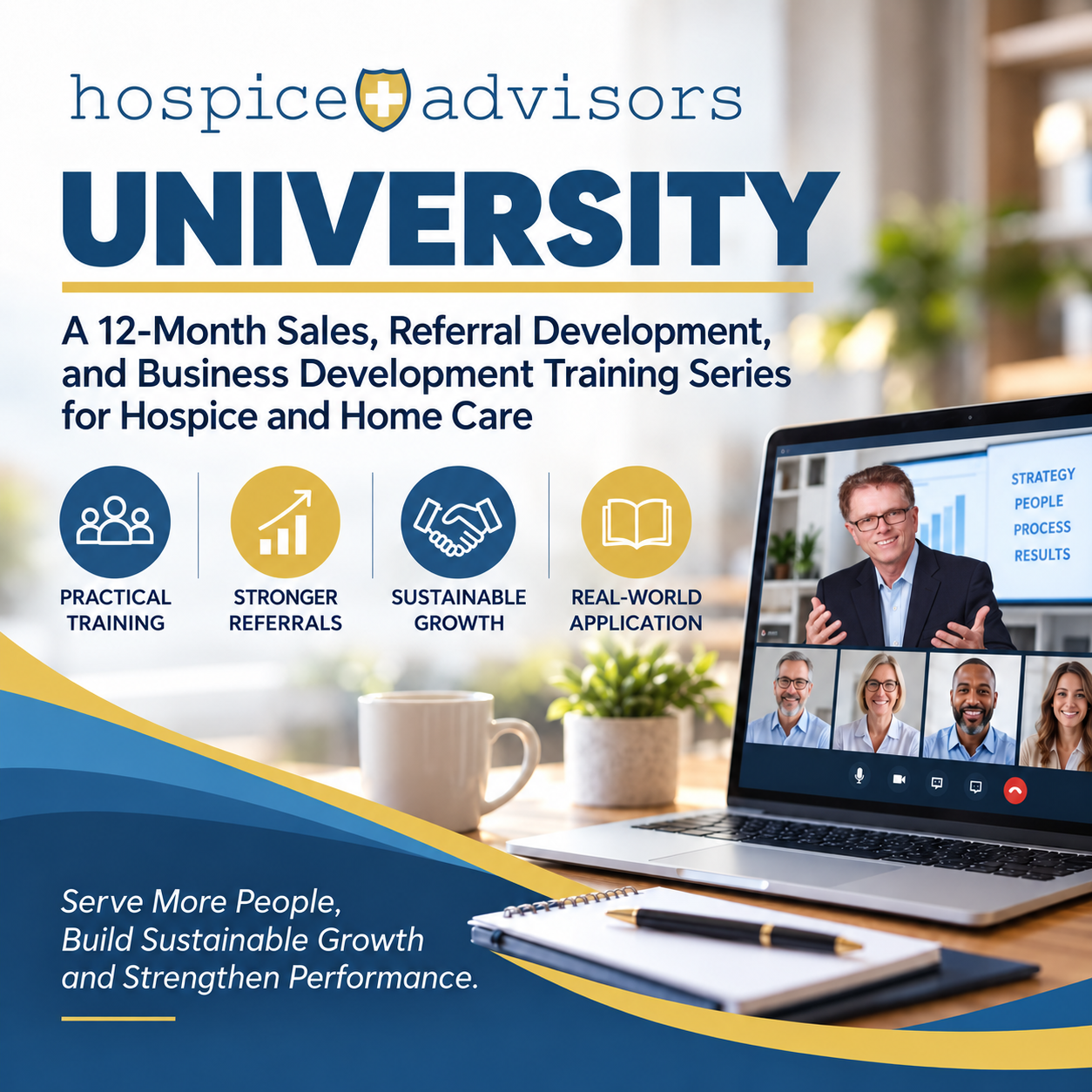
Hospice Advisors University
“Serve More People, Build Sustainable Growth and Strengthen Performance Curriculum.”
A 12-Month Sales, Referral Development, and Business Development Training Series for Hospice and Home Care
Program Description
Sustainable growth requires a clear strategy, strong relationships, disciplined execution, and a team equipped to turn opportunities into action.
This 12-month education series provides 90 minutes of focused virtual training each month to strengthen your organization’s sales model, sharpen referral development skills, and build the competencies needed to serve more people.
The program connects strategy with everyday practice. Participants learn how to identify promising referral opportunities, communicate their organization’s value, conduct productive sales conversations, overcome barriers, and strengthen the process from referral inquiry to admission.
We approach growth as a companywide initiative. Sales and business development teams create opportunities, while leadership, intake, clinical, and operational teams help turn those opportunities into responsive service and lasting relationships.
Who Can Benefit
The series is designed for:
- Sales and business development professionals, including account executives, community liaisons, clinical liaisons, and referral development staff.
- Senior leaders responsible for growth, strategy, and organizational performance.
- Owners, executive directors, and administrators seeking a more consistent and accountable approach to growth.
- Intake, admissions, clinical, and operational leaders whose work influences access, responsiveness, and referral partner satisfaction.
- Emerging leaders and other team members interested in developing business development skills.
- Onboarding of New Satt, this offering is a perfect opportunity to training new staff.
Participation across departments helps establish a shared understanding of growth goals and each team’s role in achieving them.
How the Training Works
- Begin at any time. Your organization can start its 12-month series throughout the year.
- Establish a consistent schedule. A recurring monthly day and time will be coordinated with your organization.
- Participate virtually. Each 90-minute session is delivered through Zoom.
- Include your team. Your organization’s tuition covers unlimited participants from your organization.
- Receive supporting materials. Each session includes the presentation slide deck and applicable handouts, worksheets, or practical tools.
- Apply the learning. Sessions connect the monthly topic to real situations, team discussion, and actions participants can use in their work.
The 12-Month Curriculum
Practical Skills and Strategies to Serve More People and Build Sustainable Growth
- Month 1: Building a Companywide Culture of Growth
Establish a shared understanding of growth as a means of expanding access and serving more people. Examine how leadership, sales, intake, clinical care, and operations influence results, and identify internal barriers that limit progress. Learn how to harness the strengths of the Interdisciplinary Team and create a collaborative approach in which clinical and business development staff co-manage key accounts. - Month 2: Strengthening Your Sales and Referral Development Model
Build a disciplined sales model with clear roles, expectations, and accountability. Learn a seven-step sales process that includes making an effective cold call, qualifying opportunities, uncovering needs, communicating value, and securing next steps. Strengthen territory and account management skills, establish consistent follow-up practices, and learn how to “weed the garden” by redirecting effort from unproductive accounts to promising opportunities. - Month 3: Selling on Value Across 10 Key Referral Segments
Broaden your referral strategy beyond hospitals, physicians, and skilled nursing facilities. Explore 10 key referral segments, including overlooked opportunities that can support earlier access to care and potentially longer lengths of stay. Learn how to evaluate market potential, assess competitive positioning, and tailor your value proposition to each segment. Use account segmentation to focus time and resources where your organization can create the greatest value. - Month 4: Developing an Effective Hospital Growth Strategy
Understand the hospital as a “mini city,” with distinct departments, decision-makers, priorities, and referral pathways. Develop a hospital account strategy aligned with your organization’s growth objectives. Learn 11 practical tools for building relationships, navigating hospital culture, and supporting timely transitions to care. This session is especially valuable for clinical liaisons and business development professionals working in hospital settings. - Month 5: Building a High-Performing Senior Living Community Growth Strategy
Develop a focused strategy for assisted living, independent living, retirement communities and memory care communities. Examine five major dissatisfiers that weaken relationships between senior living communities and hospice providers, and learn how to address them through specific service commitments and programs. Move beyond general claims about quality and compassion to demonstrate value for residents, families, and community staff. Build relationships that position your organization as a trusted partner. - Month 6: Engaging Community Physicians Through Strong Medical Leadership
Strengthen community physician engagement by first activating the expertise and relationships of your own medical director and provider team. Learn practical strategies for understanding physician priorities, building credibility, and communicating the value of your services. Explore the Triple A physician referral development strategy and the role of a Physician Advisory Board in strengthening community relationships. Receive a Physician Advisory Board Playbook to guide implementation. - Month 7: Developing Referral Partnerships That Support Earlier Access to Care
Explore specific strategies for partnering with private duty home care agencies, skilled home health providers, disease-focused associations, and faith-based communities. Understand how each segment operates, whom it serves, and what it needs from a care partner. Learn how to develop relevant value propositions and referral approaches that help identify appropriate patients earlier, expand access, and support longer lengths of stay when clinically appropriate. - Month 8: Building a High-Performing Referral Inquiry-to-Admission Process
Examine the full journey from the first inquiry to admission or the start of services. Learn five essential elements of an effective intake process and identify barriers that cause delays, missed opportunities, and frustration for patients, families, and referral partners. Understand why the pending referral list can be a salesperson’s most valuable account. Strengthen coordination among business development, intake, and clinical teams to improve responsiveness, follow-through, and appropriate referral conversion. - Month 9: Creating and Marketing Meaningful Differentiation
Learn how to distinguish your organization in a competitive market through capabilities that address real customer needs. Use the voice of the customer to develop credible clinical, programmatic, partnership, and professional differentiators. Explore specific examples and learn how to create, communicate, and deliver your own. Connect differentiation to stronger referral relationships, greater market relevance, and sustainable census growth. - Month 10: Using Service Excellence to Strengthen Growth
Explore how responsiveness, reliability, communication, and follow-through shape the confidence of patients, families, and referral partners. Learn the fundamentals of service excellence, including setting clear expectations, anticipating needs, and consistently keeping commitments. Develop service recovery approaches that address concerns and rebuild trust when service falls short. Connect these practices to a stronger care experience, improved CAHPS performance, and sustained referral relationships. - Month 11: Measuring Performance and Coaching for Improvement
Select meaningful measures of sales activity, account development, referrals, conversion, and growth. Learn how to distinguish productive activity from activity that does not advance an account. Use performance discussions and practical coaching to identify skill gaps, reinforce effective behaviors, and strengthen execution. Build accountability that helps staff understand their results and take specific steps to improve them. - Month 12: Creating Your Next 12-Month Growth Action Plan
Translate the year’s learning into a practical growth plan with clear priorities, account strategies, actions, measures, and ownership. Learn how to build and maintain a Quarterly Growth Plan that supports your annual objectives and adapts to changing conditions. Become the CEO of your territory by taking ownership of its opportunities, relationships, and results. Receive an example of a well-developed Quarterly Growth Plan to use as a roadmap for implementation.
What Participants Will Gain
By the end of the series, participants will be better equipped to:
- Increase the number of admissions, enhance length-of-stay and grow census.
- Communicate a clear and relevant value proposition.
- Collaborate with team members to create a culture of growth and serve more people.
- Prioritize referral sources and develop purposeful account plans.
- Conduct effective sales conversations and follow through consistently.
- Recognize and address barriers to referrals and admissions.
- Coordinate growth efforts across departments.
- Use performance measures to guide action and improvement.
The goal is to build the skills, habits, and shared accountability that help your organization serve more people and sustain growth.
Tuition and Registration
Tuition for the 12-month program is $1,200 per organization, equivalent to $100 per month, and includes unlimited participants from your organization. Full payment is required before the program begins.
For more information, contact Kurt Kazanowski at 734-658-6162 or Kurt@hospiceavisors.com.